

The six minerals regulated as asbestos cause the same diseases, but they aren't interchangeable.1 They come from two different mineral families, take two different fiber shapes, were mined in different places for different uses, and differ in how dangerous they are fiber for fiber. This page covers what the six share, how the two families behave, and what sets each one apart, with a full page behind every one. For the broader story of what asbestos is and why it was used, see our main asbestos page.
If you or a family member has been diagnosed with mesothelioma, lung cancer, or asbestosis, call 833-4-ASBESTOS to find out whether you have a claim. The type of asbestos you were exposed to, and the products it was in, can matter to your case.
You don't need the product names or old records. No fee unless we recover compensation for your family.
What makes a mineral "asbestos"
The key idea is that asbestos is defined by a physical form, not just a chemistry. Geologists call that form the "asbestiform habit." A mineral only counts as asbestos if it grew as long, thin, separable fibers, rather than as ordinary blocky crystals.2 It's a bit like the difference between water and ice: same substance, very different consequences depending on the form it takes. The same mineral that forms harmless blocky crystals in one rock can grow as deadly fibers in another.
The two families: serpentine and amphibole
Those six minerals fall into two families that behave very differently:
- Chrysotile, the serpentine type, also called white asbestos, has curly, flexible fibers. Each fiber is a microscopic sheet that has rolled itself into a hollow tube. Because the fibers bend instead of snapping, chrysotile could be spun and woven like cotton, which is part of why it became about 95 percent of all asbestos ever used.2
- The other five, the amphibole types (crocidolite, amosite, tremolite, actinolite, and anthophyllite), have straight, stiff, needle-like fibers. They split lengthwise into fine needles that lodge deep in the lungs.
Both families cause the same diseases. The amphiboles tend to persist in the body longer and are, fiber for fiber, generally more potent, but there's no safe form of asbestos and no safe level of exposure to any of them.1
The mineralogy in depth: why sheets curl into tubes and chains split into needles
Every silicate mineral, asbestos included, is built from a single building block: the silica tetrahedron, one silicon atom surrounded by four oxygen atoms. What separates one silicate mineral from another is how those tetrahedra link together.
In the serpentine family that chrysotile belongs to, the tetrahedra link into flat sheets. Chrysotile's sheet is actually two bonded layers of slightly different sizes, and the size mismatch puts the sheet under strain. It relieves that strain by curling, the way a bimetallic strip curls when heated, until it rolls up into a hollow tube about 20 to 40 nanometers across. Every chrysotile fiber is one of these rolled tubes.2 (The serpentine family has two close cousins, antigorite and lizardite, with the same chemistry, but they relieve the strain by staying flat or corrugated instead of rolling, so they don't form asbestos fibers.)
In the amphibole family that the other five belong to, the tetrahedra link into double chains that run the length of the crystal. The bonds along the chains are strong; the bonds between chains are weaker. So when the crystal breaks, it splits lengthwise along the chains into long, thin, solid needles rather than breaking across. That's the opposite of chrysotile's hollow rolled tube, and it's why the amphiboles are stiff needles while chrysotile is a flexible tube.
Several of these minerals get a different name only when they grow in the asbestos form:
| Asbestos name | Non-asbestos form of the same mineral |
|---|---|
| Chrysotile | Antigorite, lizardite |
| Crocidolite | Riebeckite |
| Amosite | Grunerite (cummingtonite-grunerite series) |
| Tremolite asbestos | Tremolite |
| Actinolite asbestos | Actinolite |
| Anthophyllite asbestos | Anthophyllite |
This is why "what type of asbestos was it" and "was it really asbestos at all" are such common questions in asbestos cases. The answers depend on both the mineral and the form it grew in.
The six asbestos minerals
Each of the six has its own history, chemistry, uses, and health record, covered in depth on its own page. Here's the overview, with links to each.
| Mineral | Common name | Color | Family | Fiber type | What it's known for |
|---|---|---|---|---|---|
| Chrysotile | White asbestos | White to pale green | Serpentine | Hollow, curly tubes | About 95% of all asbestos ever used; in thousands of products |
| Crocidolite | Blue asbestos | Lavender-blue | Amphibole | Straight needles | Generally considered the most potent at causing mesothelioma |
| Amosite | Brown asbestos | Brown to gray-brown | Amphibole | Straight needles | The Navy's insulation fiber; from a single region of South Africa |
| Tremolite | — | White to gray | Amphibole | Straight needles | The contaminant in talc and in the Libby, Montana vermiculite |
| Actinolite | — | Green to dark green | Amphibole | Straight needles | Tremolite's iron-rich twin; matters mainly as a contaminant |
| Anthophyllite | — | White to brown | Amphibole | Straight needles | Started the American asbestos industry; mined in Finland |
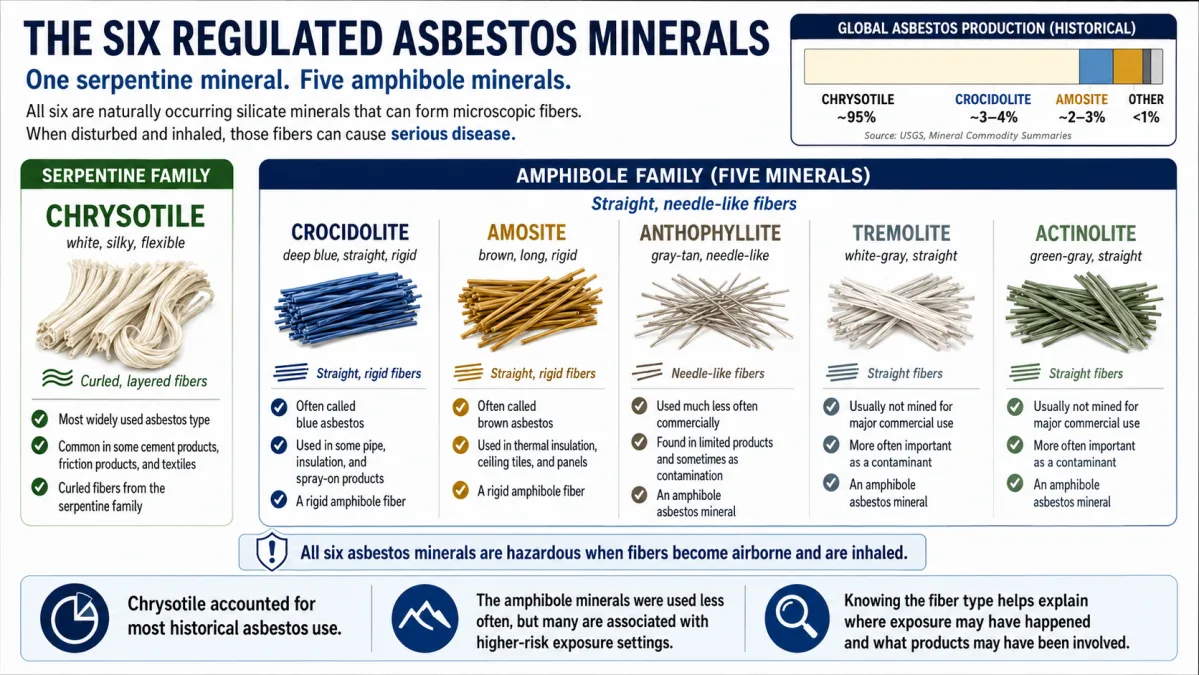
Chrysotile (white asbestos) is the only one of the six that isn't an amphibole, and it's by far the most common. Its curly, flexible fibers could be spun and woven, and it was cheap and found on nearly every continent, so it ended up in thousands of products. The industry argued for decades that chrysotile was the "safe" kind of asbestos. Every major health authority rejects that. It causes the same diseases as the rest, and it was the last form of asbestos still used in the United States until the EPA banned it in 2024.3
Crocidolite (blue asbestos) is generally considered the most potent of the six at causing mesothelioma, and it was at the center of the 1960 discovery that asbestos could kill people who merely lived near the mines.4 It was mined in South Africa and Australia and used most in asbestos-cement water pipe, in wartime gas mask filters, and, briefly, in Kent cigarette filters.
Amosite (brown asbestos) came from a single region of South Africa and almost nowhere else. Its long, iron-rich fibers resisted heat and seawater, which made it the U.S. Navy's preferred insulation and exposed huge numbers of shipyard workers and veterans.
Tremolite was barely a commercial product, but it's the contaminant that turns up in talcum powder and in the vermiculite that poisoned Libby, Montana. Most people exposed to it never knew.
Actinolite is tremolite's greener, iron-rich twin. It was essentially never mined, and it matters, like tremolite, as a contaminant and in naturally occurring rock. Our actinolite page covers what's specific to it and points to the tremolite page for the rest.
Anthophyllite is the fiber that started the American asbestos industry, the one Henry Ward Johns built his roofing company on before it became Johns-Manville. It was mined heavily in Finland and used where acid resistance mattered.
What the six look like
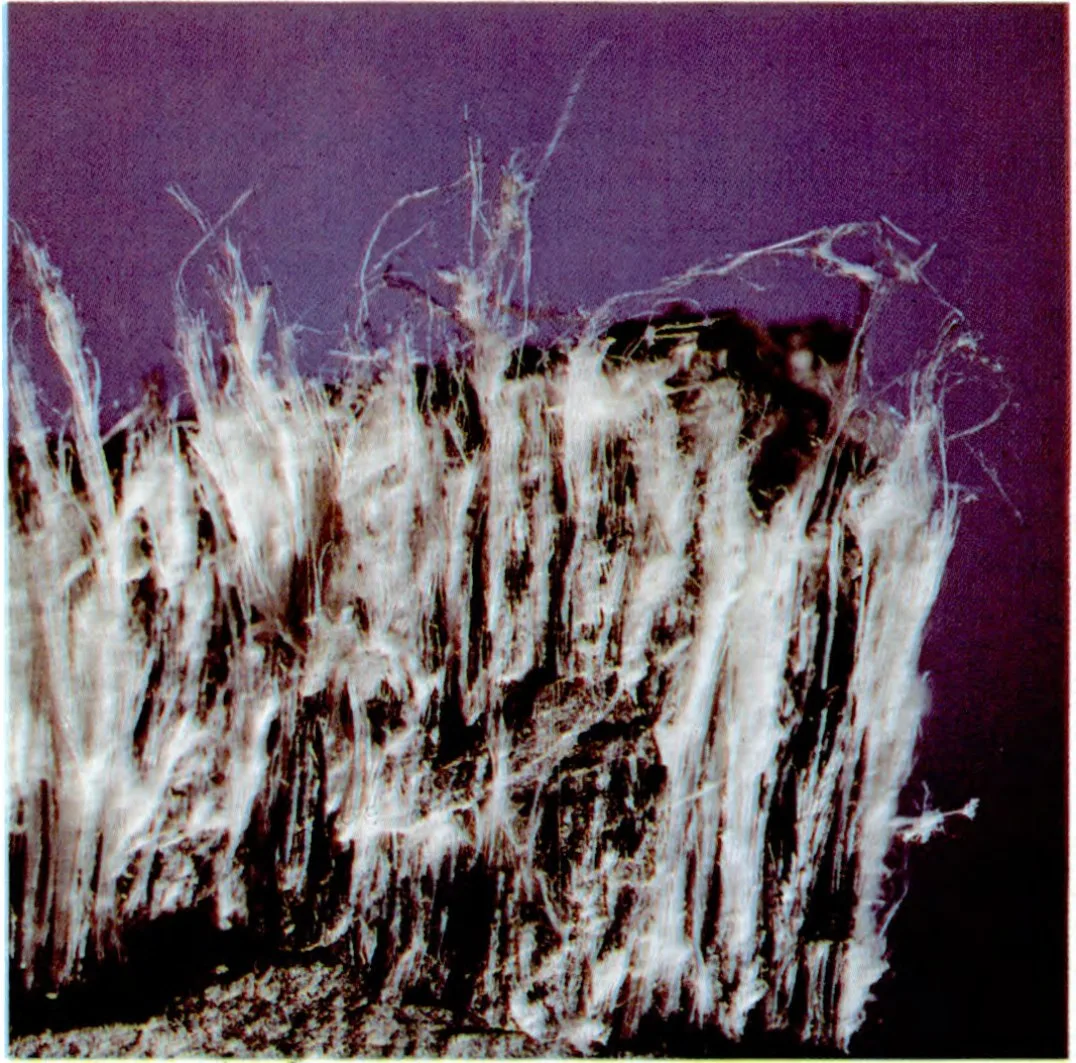
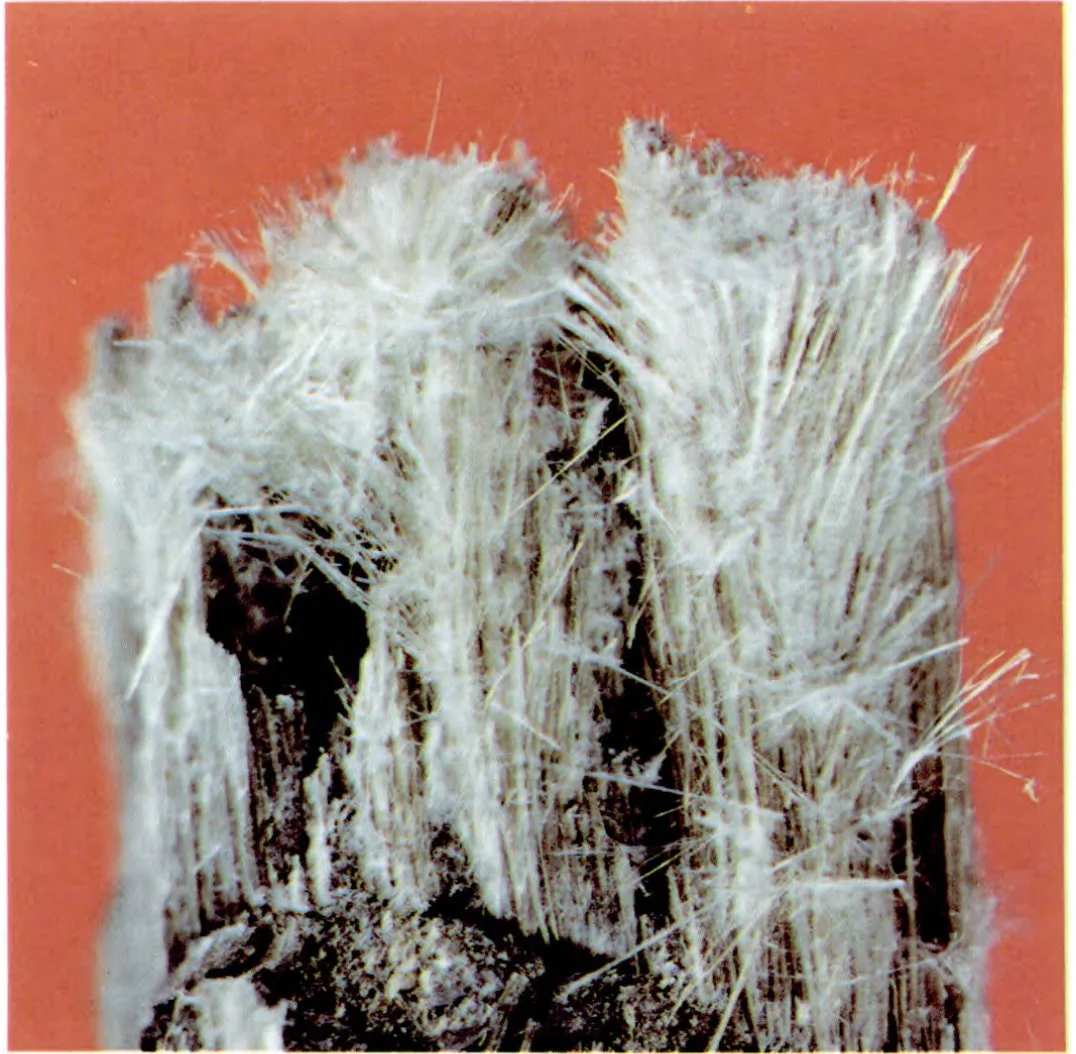
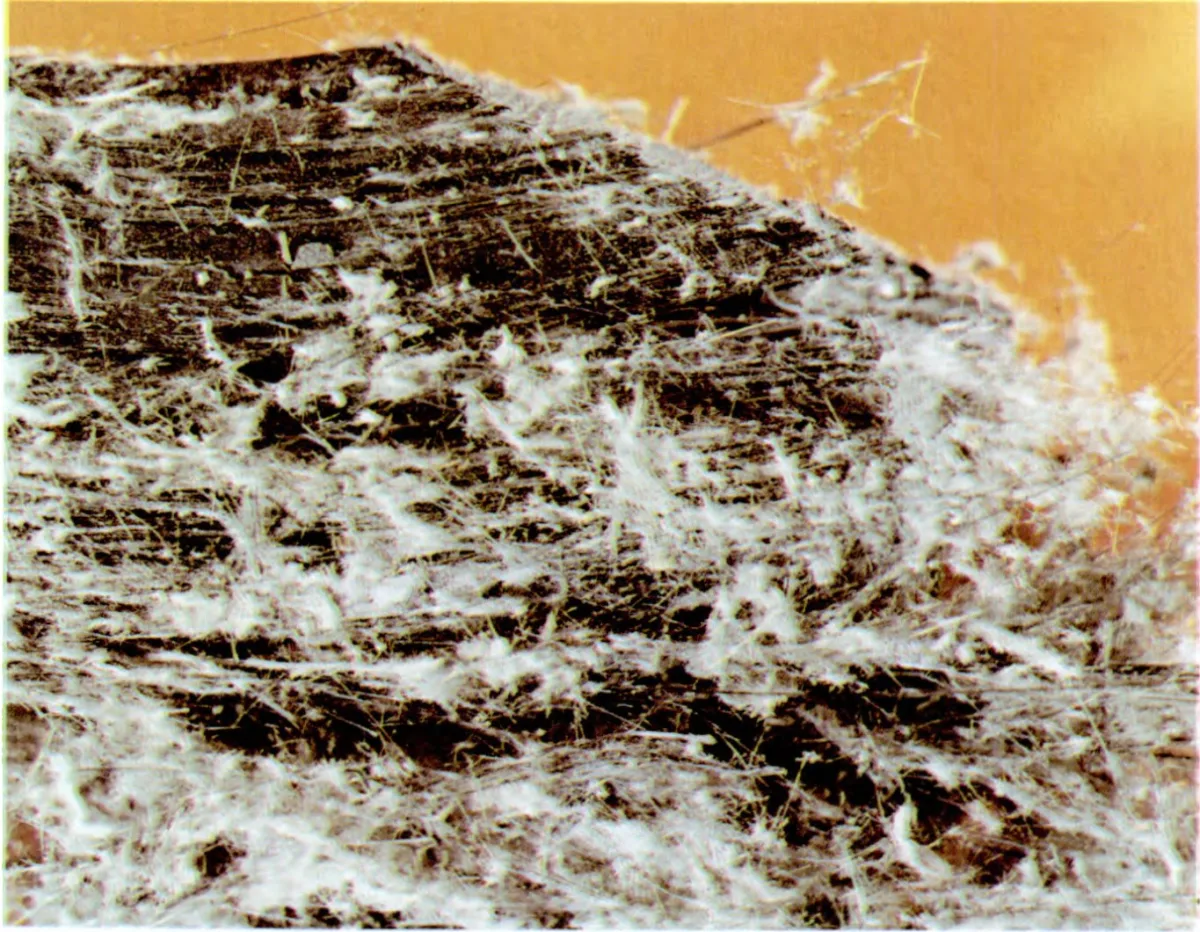
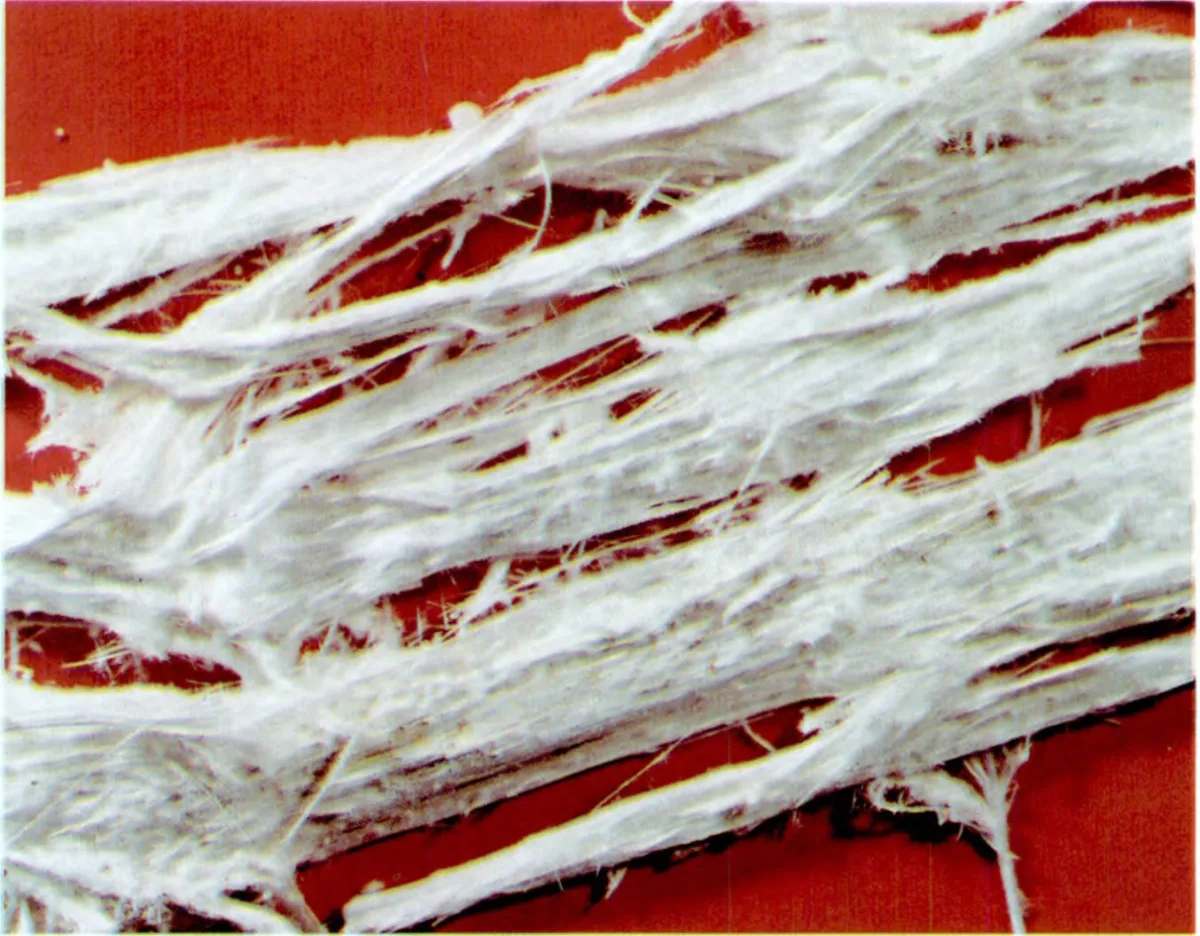
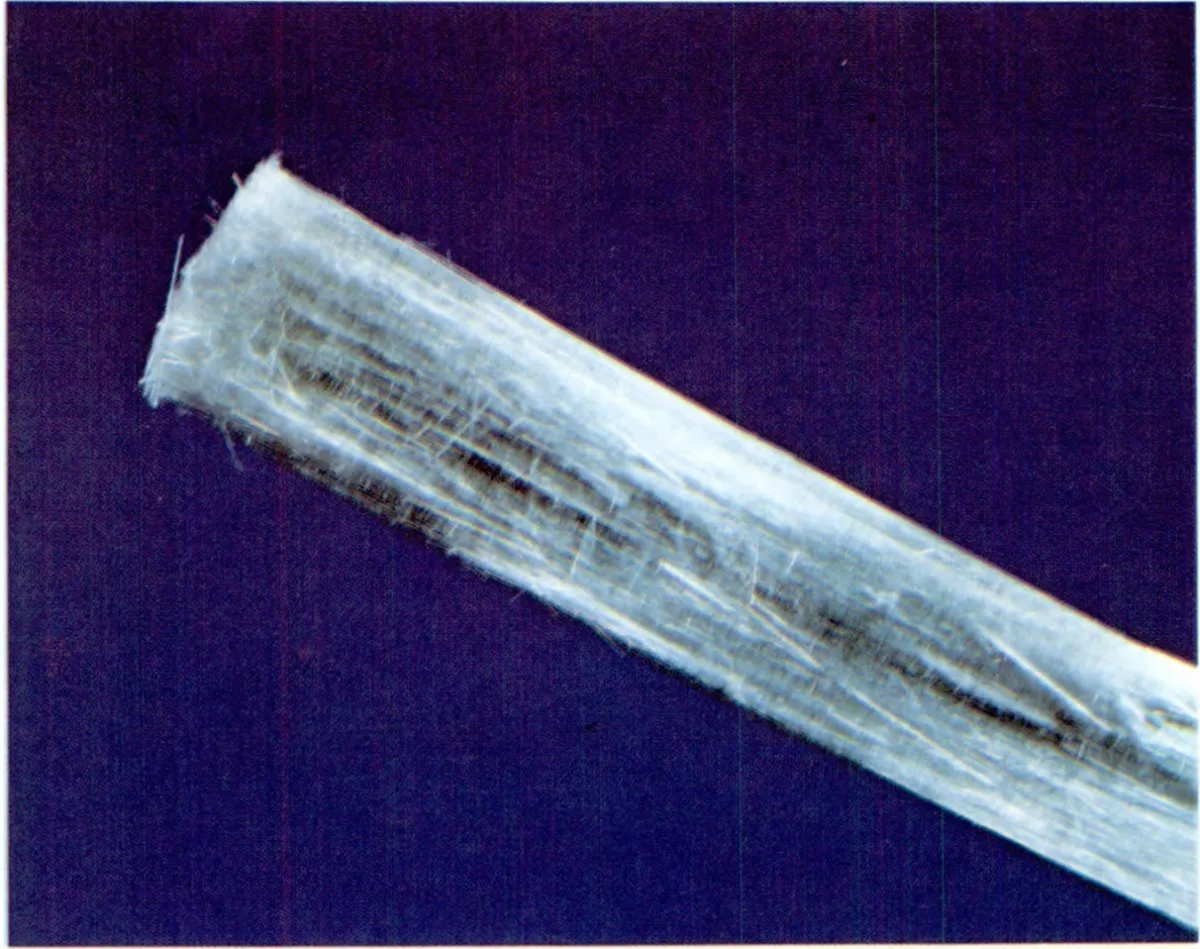
Close-ups (×3) of the asbestos variety of each mineral, photographed by the U.S. Bureau of Mines in 1977. Each page also shows the ordinary, nonfibrous form of the same mineral beside it.
| Chrysotile | Amosite | Crocidolite |
|---|---|---|
 |
 |
 |
| Tremolite | Actinolite | Anthophyllite |
 |
 |
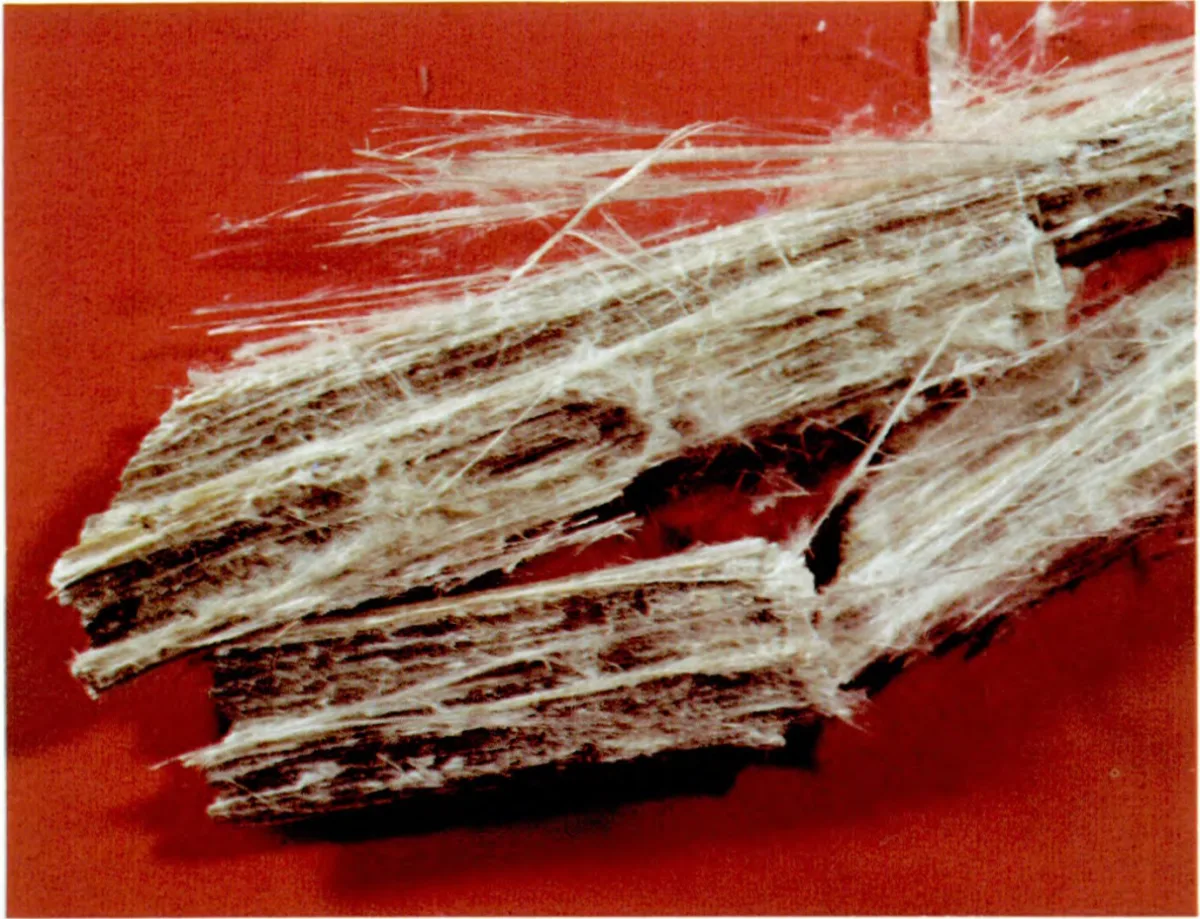 |
U.S. Bureau of Mines, Selected Silicate Minerals and Their Asbestiform Varieties, Information Circular 8751 (1977), figs. 2–7 (ACL Doc 10936, pp. 14–19).
How the industry compared them
In 1975 the British asbestos industry's information body published this comparison of the six. Chrysotile was the flexible, silky fiber that could be spun and woven; crocidolite the strongest; and amosite resisted heat. Anthophyllite, tremolite and actinolite were brittle and weak, which is why they had few commercial uses of their own.
| Property | Chrysotile | Crocidolite | Amosite | Anthophyllite | Tremolite | Actinolite |
|---|---|---|---|---|---|---|
| Color | Usually white to pale green; yellow or pink from some deposits | Blue | Light gray to pale brown | White to gray, pale brown | White to gray | Pale to dark green |
| Breaks down at (°C) | 450–700 | 400–600 | 600–800 | 600–850 | 950–1040 | 620–960 |
| Resistance to acids | Fairly rapid attack | Good | Attacked slowly | Very good | Very good | Attacked slowly |
| Resistance to alkalis | Very good | Good | Good | Very good | Good | Good |
| Average tensile strength (thousand psi) | 440 | 495 | 250 | under 100 | under 70 | under 70 |
| Texture | Usually flexible, silky and tough | Flexible to brittle, and tough | Usually brittle | Usually brittle | Usually brittle | — |
| Producing countries (1975) | USSR, Canada, China, Rhodesia, USA, Italy, South Africa, Swaziland | South Africa | South Africa | Finland, USA, Mozambique | USA, Italy | — |
Asbestos Information Committee, Asbestos: Its Special Attributes and Uses (1975), Table 1 (ACL Doc 24432, p. 6). "Breaks down" is the temperature at which the fiber loses its water and most of its strength.
The same booklet showed which fiber lengths went into which products: the longest fiber into textiles, shorter grades into insulation, asbestos-cement, brakes and paper, and the shortest into plastics and floor tiles.
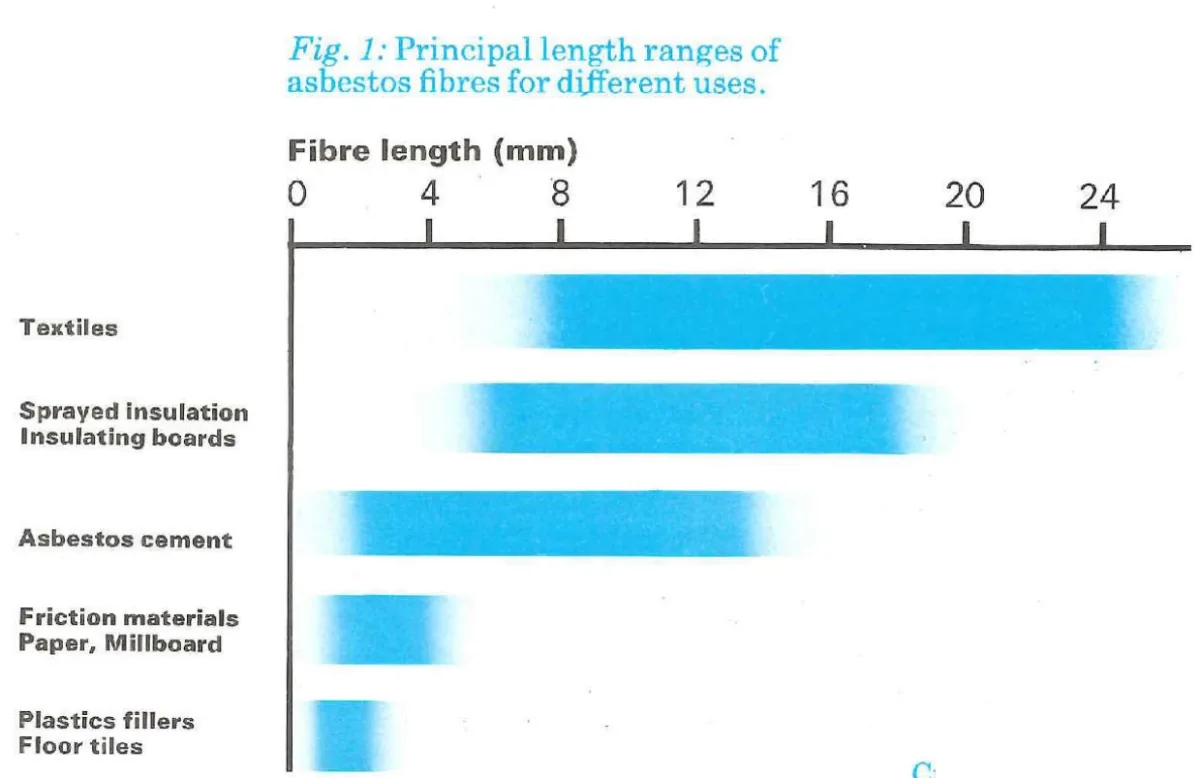
Asbestos Information Committee, Asbestos: Its Special Attributes and Uses (1975), fig. 1 (ACL Doc 24432, p. 5).
Where they occur in American bedrock
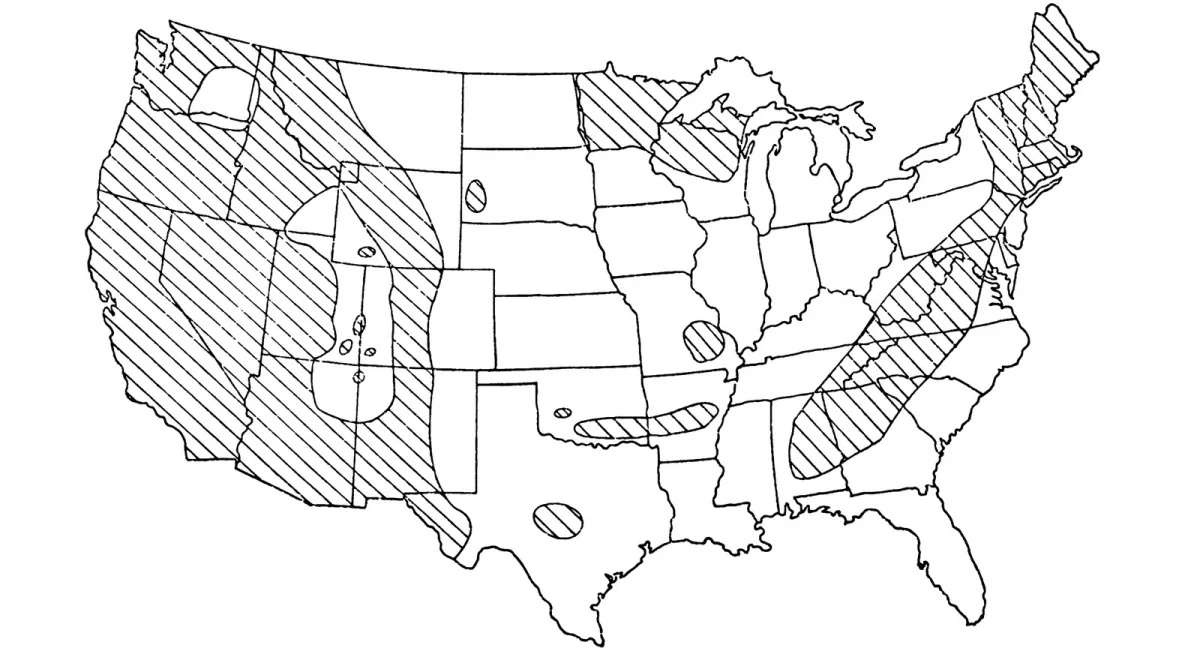
Regions of the United States that the Environmental Protection Agency reported to contain asbestos minerals in the bedrock. U.S. Bureau of Mines, Selected Silicate Minerals and Their Asbestiform Varieties, Information Circular 8751 (1977), fig. 1 (ACL Doc 10936, p. 10) Disturbing that rock by quarrying, road building or digging can release naturally occurring asbestos.
Were you exposed to a specific type of asbestos?
Knowing which mineral, and which product, you were exposed to is part of building an asbestos claim. If you've been diagnosed with mesothelioma, lung cancer, or asbestosis, we can help trace the exposure back to its source, whether that's a job, a product, military service, or a contaminated mineral like the tremolite in talc.
Call 833-4-ASBESTOS to speak with our litigation team. There's no fee unless we recover compensation for your family.
References
- IARC. Arsenic, Metals, Fibres, and Dusts. IARC Monographs on the Evaluation of Carcinogenic Risks to Humans, Vol 100C. International Agency for Research on Cancer; 2012.
- Virta RL. Asbestos: Geology, Mineralogy, Mining, and Uses. US Geological Survey Open-File Report 02-149. US Department of the Interior, US Geological Survey; 2002.
- US Environmental Protection Agency. Asbestos Part 1; chrysotile asbestos; regulation of certain conditions of use under the Toxic Substances Control Act (TSCA). Final rule. Fed Regist. 2024;89(61):21970-22010.
- Wagner JC, Sleggs CA, Marchand P. Diffuse pleural mesothelioma and asbestos exposure in the North Western Cape Province. Br J Ind Med. 1960;17(4):260-271.
Key Sources
Hodgson AA. Fibrous Silicates. Lecture Series 1965, No. 4. Royal Institute of Chemistry; 1966.
Campbell WJ, Blake RL, Brown LL, Cather EE, Sjoberg JJ. Selected Silicate Minerals and Their Asbestiform Varieties: Mineralogical Definitions and Identification-Characterization. Information Circular 8751. US Bureau of Mines; 1977.
Asbestos Information Committee. Asbestos: Its Special Attributes and Uses. Asbestos Information Committee; 1975.
Badollet MS. Asbestos, a mineral of unparalleled properties. Transactions of the Canadian Institute of Mining and Metallurgy. 1951;54:151-160.
In the research library
The National Library of Medicine indexes 520 studies in our medical research library under amphibole asbestos. Among the most cited:
- Occupational exposure to chrysotile asbestos and cancer risk: a review of the amphibole hypothesisL.T. Stayner, D.A. Dankovic, R.A. Lemen, 1996 · American Journal of Public Health · cited 154 times
- Pleural mesothelioma cases in Biancavilla are related to a new fluoro-edenite fibrous amphiboleP. Comba, A. Gianfagna, L. Paoletti, 2003 · Archives of Environmental Health · cited 83 times
- An evaluation of the risks of lung cancer and mesothelioma from exposure to amphibole cleavage fragmentsJ.F. Gamble, G.W. Gibbs, 2008 · Regulatory Toxicology and Pharmacology · cited 74 times
- Mortality in a cohort of vermiculite miners exposed to fibrous amphibole in Libby, MontanaJ.C. McDonald, J. Harris, B. Armstrong, 2004 · Occupational and Environmental Medicine · cited 71 times
- Relation between asbestosis and bronchial cancer in amphibole asbestos minersG.K. Sluis-Cremer, B.N. Bezuidenhout, 1989 · British Journal of Industrial Medicine · cited 57 times
Frequently asked questions
What are the types of asbestos?
There are six regulated types. One, chrysotile (white asbestos), belongs to the serpentine family and has curly, flexible fibers. The other five, crocidolite, amosite, tremolite, actinolite, and anthophyllite, are amphiboles, with straight, needle-like fibers. They cause the same diseases but differ in potency, and each has its own page above.
What's the difference between serpentine and amphibole asbestos?
It's the shape of the fiber, which comes from how the mineral is built. Serpentine (chrysotile) forms curly, hollow tubes that bend; the amphiboles form straight, solid needles that split lengthwise. The amphiboles tend to stay in the body longer and are generally more potent fiber for fiber, but every type causes cancer.
Which type of asbestos is the most dangerous?
Crocidolite (blue asbestos) is generally considered the most potent at causing mesothelioma, with amosite often placed next. But all six cause mesothelioma, lung cancer, and asbestosis, and there is no safe type and no safe level of exposure to any of them.
Is chrysotile (white asbestos) safe?
No. The industry argued for decades that chrysotile's curly fibers made it safe, but every major health authority rejects that. It causes the same diseases as the other types and was the last form still in use in the United States until the EPA banned it in 2024.
Which type of asbestos is in talc?
Tremolite. Talc and tremolite form in the same rock, so talc deposits can be contaminated with tremolite asbestos, which is the basis for the talcum-powder lawsuits. See tremolite for more.
Does the type of asbestos matter to my claim?
It can. The mineral, the form it grew in, and the product it was in all bear on where and how you were exposed, which companies are responsible, and which bankruptcy trusts may apply. Our team works that out as part of your case.
Talk with an asbestos lawyer
Start with what you remember, and we'll take it from there.
Latest news about Types of Asbestos
Mar 62025
Study
Communicating the Health Risks of Fibrous Minerals to Society
A 2024 review by researchers in Spain and Italy argues that the public still doesn't understand asbestos risks, and that clearer communication could prevent disease.
Aug 142024
From the archives
Asbestos Exposed: The Shocking Revelations from Saranac Labs, Part 1
In the 1930s, the asbestos industry paid for research on asbestos dust, and kept the right to decide what got published. The Saranac Laboratory letters show how.
This page is provided for general informational purposes and does not constitute legal advice. Every asbestos case turns on its own facts, exposure history, diagnosis, deadlines, available evidence, and applicable law. Reviewing this page does not create an attorney-client relationship. For advice about your specific situation, call 833-4-ASBESTOS for a free case review.